By 2025, the Indian job market has become highly competitive.End-to-End Job Search Plan.
Simply applying to many jobs is no longer enough.
To get hired, you need a clear and structured job search strategy.
This includes:
- Setting career goals
- Building the right skills
- Preparing for interviews
- Networking with professionals
- Negotiating job offers
This guide is useful for:
- Fresh graduates
- Experienced professionals
- Career switchers
Let’s explore each step in a simple way.
Understanding Today’s Job Market in India
The Indian job market is growing fast.
This growth is driven by:
- Digital transformation
- Startups and innovation
- Gig economy jobs
- Expansion in Tier-2 cities
Many industries are hiring actively, such as:
- IT and software development
- Fintech
- Edtech
- Healthcare
- E-commerce
- Digital marketing
Recruiters now use tools like:
- ATS (Applicant Tracking Systems)
- LinkedIn screening
- Employee referrals
Because of this, passive job searching rarely works.
You must take active steps to stand out.
Step 1: Set a Clear Career Goal
A clear career goal gives direction.
Without a goal, your job search becomes confusing.
Define Your Target Role
Ask yourself:
- What job role do I want?
- Which city do I prefer?
- What salary range do I expect?
- What type of company suits me?
Example:
“Get a Junior Data Analyst role in Bengaluru with a salary of 4–7 LPA within 6 months.”
Use the SMART Framework
SMART goals are:
- Specific — Clearly defined
- Measurable — Trackable
- Achievable — Realistic
- Relevant — Matches your skills
- Time-bound — Has a deadline
This method keeps your job search focused.
Step 2: Evaluate and Improve Your Skills
Employers prefer industry-relevant skills.
Degrees alone are not enough.
Analyze Job Descriptions
Collect 10–15 job descriptions from platforms like:
- Naukri
- Foundit
Look for:
- Common technical skills
- Popular tools
- Required certifications
Make a list of these skills.
Identify Skill Gaps
Compare:
- Your current skills
- Required industry skills
Focus on learning missing skills.
Learn Through Courses and Projects
You can improve skills through:
- Online courses
- Internships
- Freelancing
- Personal projects
Example:
If you want to become a web developer, build:
- One live website
- Two or three projects
- A portfolio to showcase your work
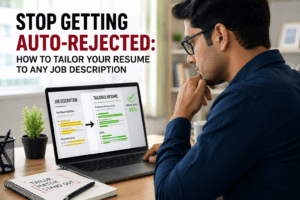
Step 3: Create an ATS-Friendly Resume and Cover Letter
Your resume is your first impression.
It must be clear and professional.
Use Simple Resume Format
Follow these rules:
- Use clear headings
- Keep layout simple
- Avoid graphics and designs
- Use standard fonts
Simple resumes perform better in ATS systems.
Use Keywords from Job Descriptions
Include skills mentioned in the job posting.
Example:
Instead of writing:
“Worked on social media”
Write:
“Increased social media engagement by 35% in three months.”
Numbers make your resume stronger.
Write a Custom Cover Letter
Create a template and customize it for each job.
Mention:
- Why you are interested
- Why you fit the role
- How your skills match
Avoid copying the same letter for every job.
Step 4: Optimize Your LinkedIn and Job Portal Profiles
Your online profile acts as your digital resume.
Recruiters often check profiles before contacting candidates.
Improve Your LinkedIn Profile
Make sure your profile includes:
- Professional profile photo
- Clear headline
- Detailed About section
- Updated experience
- Skill keywords
Post regularly about:
- Projects
- Industry knowledge
- Learning updates
This improves visibility.
Update Job Portal Profiles
Complete your profile on:
- Naukri
- Foundit
- Shine
- Internshala
Use relevant keywords.
Update profiles every 2–3 months.
Respond to recruiter messages quickly.
Step 5: Apply Smartly on Job Portals
Applying randomly wastes time.
Instead, apply strategically.
Focus on Quality Applications
Filter jobs based on:
- Job role
- Location
- Salary range
- Experience level
Apply within 48 hours of job posting.
Early applications get better visibility.
Track Your Applications
Maintain a simple tracking sheet.
Include:
- Company name
- Role
- Application date
- Status
This keeps your job search organized.
Step 6: Use Networking and Referrals
Referrals increase your chances of selection.
Many jobs are filled through internal recommendations.
Connect With Professionals
Use LinkedIn to:
- Find employees in target companies
- Send polite messages
- Ask for advice
Avoid sending generic messages.
Be respectful and professional.
Join Communities
Participate in:
- Alumni groups
- Professional forums
- WhatsApp career groups
- Industry webinars
These connections often lead to job opportunities.
Step 7: Follow a Weekly Job Search Routine
Consistency is important.
Treat job searching like a job.
Example Weekly Routine
Monday: Skill learning — 4 hours
Tuesday: Job applications — 3 hours
Wednesday: Resume updates — 2 hours
Thursday: Networking — 3 hours
Friday: Mock interviews — 4 hours
Saturday: Practice tests — 3–4 hours
Sunday: Rest and review progress
This routine keeps you productive.
Step 8: Prepare for Online Tests
Many companies conduct online tests before interviews.
Preparation depends on the job role.
For Technical Roles
Practice coding on:
- HackerRank
- LeetCode
- GeeksforGeeks
Focus on:
- Arrays
- Strings
- Trees
- Databases
- Operating systems
For Non-Technical Roles
Practice:
- Aptitude tests
- Logical reasoning
- Verbal ability
Use previous placement papers for practice.
Step 9: Improve Resume for ATS Shortlisting
ATS systems scan resumes automatically.
Your resume must be ATS-friendly.
Use Matching Keywords
Your resume should match 60–70% of job keywords.
Avoid:
- Images
- Graphics
- Multi-column layouts
Use:
- Simple format
- Standard fonts
- PDF format (unless told otherwise)
Step 10: Prepare for Interviews
Interview preparation increases success rate.
Plan preparation based on interview type.
HR Interview Preparation
Prepare answers for:
- Behavioral questions
- Strengths and weaknesses
- Career goals
Use the STAR method to structure answers.
Research:
- Company background
- Products
- Company culture
Technical Interview Preparation
Review:
- Core concepts
- Past projects
- Problem-solving methods
Be ready for:
- Coding challenges
- Case studies
- Technical explanations
Step 11: Practice Mock Interviews
Mock interviews improve confidence.
They simulate real interview situations.
Benefits of Mock Interviews
Mock interviews help you:
- Improve speaking skills
- Reduce nervousness
- Identify weak areas
- Improve body language
Recording your answers helps self-analysis.
Step 12: Negotiate Job Offers Smartly
Salary is important, but not the only factor.
Evaluate the full offer.
Check These Factors
Before accepting:
- Salary package
- Learning opportunities
- Company growth
- Work culture
- Location cost
Always read the job contract carefully.
Negotiate politely using market data.
Step 13: Stay Consistent and Follow Up
Job searching requires patience.
Rejections are normal.
Success comes with persistence.
Follow-Up Strategy
If you do not hear back:
Send a polite follow-up message after:
- 7–10 days
Use waiting time to:
- Learn new skills
- Improve resume
- Expand network
Regular review improves results.
Frequently Asked Questions (FAQs)
A. In India, a job search can take anywhere between 1 to 6 months based on your experience, skills and job profile. For freshers, results may come early in the busy recruitment seasons while professionals may take longer due to the extended network and invitations for the professional stage of the interview process.
A. The right job search strategy is a mix of quality and quantity; apply to 8–15 specific roles each day so you can keep your efforts laser-focused. Make EVERY application unique; customized resumes and cover letters when possible. Tracking: Follow-up applications and monitor what works.
A. Using only job portals results in a low response rate due to competition. Referrals increase visibility and provide access to decision-makers which in turn, accelerates the entire process.
A. Freshers need to be able to showcase practical projects, internships or work done by him or her at the same time of their education as an instant attraction grabber.