![Why You’re Not Getting Interviews: 7 Reasons + How to Fix Them [2026]](https://lightseagreen-dotterel-289894.hostingersite.com/blog/wp-content/uploads/2026/05/word-press-blogs-jobuai-960x624-2026-05-18T100402.557.png)
You are applying. Consistently, carefully, sometimes obsessively. You are tailoring cover letters, refreshing job boards, and spending your evenings sending out applications that disappear into a digital void. And the response? Silence. The occasional automated “thank you for your interest.” No callbacks. No interview invitations. If you are sitting there asking yourself “why am I not getting interviews?” — you are not alone, and more importantly, you are asking exactly the right question. Because the answer almost always comes down to a small number of fixable problems. Not bad luck. Not an impossible market. Specific, diagnosable, solvable problems. This article identifies the seven most common ones — and tells you exactly how to fix each one.
At the end of this guide, we will also show you how Jobuai’s Job Mirror™ diagnoses exactly which of these problems is suppressing your application success — and fixes it for you with AI precision, in minutes.
First: Understand Why Applications Go Unanswered in 2026
Before we get into the specific reasons, it is worth understanding the modern application process clearly — because many job seekers are operating with a mental model that is five years out of date.
When you submit an application today, your resume does not land on a recruiter’s desk. It enters an Applicant Tracking System (ATS) — software that automatically scans, parses, and scores every application before any human reviews it. Recruiters only see applications that score above a certain threshold. Below that threshold, your application is effectively invisible, regardless of how qualified you are.
This means the question “why am I not getting interviews?” almost always has a technical answer — something specific in your resume structure, writing, or positioning causes it to score below the threshold, or below the competition. Understanding that shifts the frame from “the market is against me” to “there is something specific I can fix.” And that is a very different, much more empowering place to be.
Reason 1: Your Resume Is Not Passing the ATS Filter

ATS software rejects over 75% of resumes before a recruiter reads them. Not because the candidates are unqualified — but because the resume format, structure, or content is causing the system to score it below the threshold required to advance.
The most common ATS killers are: multi-column layouts that confuse the parser’s reading order, contact information buried in a header or footer the system cannot extract, tables and text boxes that swallow your experience data, decorative fonts that render as unreadable characters, and image-based PDFs where no text can be extracted at all.
The fix: Rebuild your resume as a clean, single-column document. Use standard fonts (Calibri, Arial, or Georgia). Place all contact information in the document body, not in headers or footers. Save as .DOCX or a text-based PDF — never as an image. Run a plain-text test: copy and paste your resume content into Notepad. If it is readable and logically ordered, your format is ATS-safe. If it is garbled, it needs work.
You can also check our detailed guide on Why Your Resume Isn’t Getting Shortlisted — and How to Fix It (2026) for more ATS optimization tips.
Reason 2: Your Resume Keywords Do Not Match the Job Description
ATS systems work by comparing the language in your resume against the language in the job description. They calculate a match percentage — and applications below the threshold get filtered out automatically. If you are using synonyms, paraphrases, or different terminology for skills the employer is specifically scanning for, your match score drops — sometimes dramatically.
This is the single most common cause of strong candidates not getting interviews. They have the skills. They have the experience. But they describe those skills in language that diverges from what the ATS was programmed to find.
A candidate who has “managed P&L statements” when the job description says “budget management” gets a lower score. A candidate whose resume says “handled customer relationships” when the posting says “customer success management” gets a lower score. These mean the same thing to a human reader — but not to an ATS.
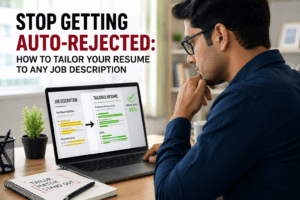
The fix: For every application, analyze the job description and mirror its exact terminology in your resume. Identify the five to eight highest-frequency keywords in the posting and confirm each one appears naturally in your document. Include both full-form and abbreviated versions of key terms (e.g., “Search Engine Optimization (SEO)”). This customization is not dishonest — it is translation. You are communicating your real skills in the language the system is designed to read.
If you are unsure how to identify the most important keywords, read our guide on How to Analyze a Job Description for Must-Have Skills (Step-by-Step + Free Tool).
Reason 3: You Are Sending a Generic Resume to Every Application
A generic resume — one you send to every application unchanged — is one of the most damaging application strategies in the modern job market. Here is why: every job description is different. Companies configure every ATS around different keyword sets. Every recruiter is looking for a specific combination of experience, skills, and positioning. A resume optimized for none of these specifically will be outscored by one optimized for each of them individually.
Many candidates resist customizing their resume because it feels time-consuming. And it is — if done manually. But the alternative — sending the same document to fifty jobs and getting zero responses — is far more time-consuming in total, and emotionally depleting in a way that manual customization is not.
The fix: Treat your resume as a template with a core structure and adjustable sections. For each application, update your Professional Summary (two to three sentences incorporating key terms from this specific posting), your Skills section (mirroring the skill terminology used in the description), and two to three experience bullets where you can naturally surface language that aligns with what employers value most for this role. This targeted approach takes fifteen to twenty minutes per application once you have a strong base resume — and the improvement in response rate is significant and consistent.
Reason 4: Your Resume Summary Is Vague or Missing Entirely
ATS systems parse the Professional Summary at the top of your resume first, making it prime keyword territory. It is also what a human recruiter reads in the first three seconds to decide whether to keep reading or move on. If your summary is missing, generic, or reads like a mission statement (“A motivated professional seeking a challenging opportunity to leverage my skills”), it is failing at both jobs simultaneously.
A well-written Professional Summary for ATS purposes should: include your target job title, naturally incorporate three to five high-priority keywords from the job description, state your years of relevant experience, and mention one concrete differentiator — a specific achievement, specialization, or capability that distinguishes your background.
The fix: Write a three to five sentence summary that is customized for each application. Start with your professional identity (e.g., “Senior Product Manager with eight years of experience in B2B SaaS”). Include role-specific keywords naturally within the description. End with something specific — not a desire, but a demonstrated capability or notable achievement that makes a recruiter want to keep reading.
Reason 5: Your Experience Bullets Describe Duties, Not Achievements
This is the most pervasive content problem in professional resumes. Candidates describe their responsibilities — what their job description said — rather than what they actually achieved. Recruiters and ATS systems both respond more strongly to achievement-oriented language than responsibility-oriented language. Advanced ATS platforms using Natural Language Processing explicitly score achievement statements higher than duty descriptions.
Compare:
- “Responsible for managing the company’s social media channels and creating content on a regular basis.”
- “Grew LinkedIn following from 3,200 to 27,000 in 11 months through a data-driven content strategy, increasing inbound lead generation by 43%.”
Both describe the same person doing the same job. One disappears into the pile. The other generates interview invitations.
The fix: Rewrite every experience bullet using the formula: Action Verb + Specific Context + Measurable Outcome. If you do not have an exact number, use approximate figures, percentages, team sizes, project scopes, or timeline improvements. Every bullet should end with a “so what” — what changed or improved because of what you did. If a bullet does not pass the “so what” test, either rewrite it or remove it.
Reason 6: You Are Applying to the Wrong Roles (or in the Wrong Way)
Sometimes the resume is not the primary problem — the strategy is. Two application strategy errors consistently suppress interview rates for otherwise well-prepared candidates:
Applying below the qualification threshold: If you consistently meet fewer than 60% of the listed requirements for roles you are applying to, your application is structurally unlikely to generate an interview. Recruiters screen for minimum qualification thresholds, and being genuinely underqualified for a role produces rejection not from bias but from arithmetic. The fix is to target roles where you meet 70% or more of the stated requirements — and to focus your stretch applications on roles where your transferable experience fills visible gaps, not just ambition.
Applying only through job aggregators: Large job boards introduce additional ATS layers and high application volumes that reduce your odds significantly. Direct applications through company career pages typically reach a less-crowded pipeline. Referral applications — where you have an internal champion — are four times more likely to result in an interview than cold applications through job boards, regardless of resume quality. Diversify your application channels, and invest meaningful time in building the referral relationships that most dramatically improve your odds.
Reason 7: Your Online Presence Does Not Reinforce Your Application
Before a recruiter picks up the phone to call you for an interview, there is a strong chance they have looked you up online. LinkedIn is checked for most professional roles. GitHub matters for engineering candidates. Portfolio sites matter for creative and product roles. What they find when they search your name either reinforces your application — or creates doubt that kills it.
An outdated LinkedIn profile with a different job history than your resume, a sparse GitHub with no activity, an absent portfolio for a role that expects one, or a social media presence that creates a discordant professional impression — any of these can silently suppress your interview rate even when your resume is strong.
The fix: Audit your online presence from the perspective of a recruiter who just received your application. Does your LinkedIn headline and summary mirror the professional identity in your resume? Does your job history match? Is your LinkedIn profile photo current and professional? For technical roles, does your GitHub show relevant activity? For creative or product roles, does your portfolio exist and reflect your current level? Close any gaps between what your resume says and what recruiters find online.

The Fastest Way to Diagnose Your Specific Problem: Job Mirror™ by Jobuai
Working through all seven of these reasons manually — auditing your resume format, analyzing keyword gaps for each application, rewriting achievement bullets, auditing your online presence, and recalibrating your application strategy — is the right work. If you do it thoroughly, you can materially improve your interview rate. But it takes time, requires honest self-assessment, and needs to be repeated with each new application you send.
That is exactly the problem that Jobuai’s Job Mirror™ was built to solve. Rather than guessing which of the seven reasons is suppressing your applications, Job Mirror™ tells you — with precision — and shows you exactly what to fix.
What Job Mirror™ Diagnoses and Fixes for You:
- ATS Compatibility Audit: Job Mirror™ parses your resume exactly as leading ATS platforms do, identifying every formatting flaw, structural issue, and parsing risk before you submit another application.
- Real-Time Keyword Gap Analysis: Paste any job description and Job Mirror™ instantly calculates your keyword match percentage, identifies every missing high-value term, and shows you exactly where and how to add them without over-stuffing.
- Application Strategy Scoring: Job Mirror™ evaluates whether the roles you are targeting align with your demonstrated qualifications — identifying the sweet spot between realistic applications and appropriate stretch roles to maximize your interview conversion rate.
- Achievement Bullet Rewriting: For any experience bullet that reads as a duty rather than an achievement, Job Mirror™ generates a specific, quantified rewrite suggestion calibrated to your actual experience and the keywords the role values most.
- Multi-Role Trend Analysis: Run Job Mirror™ across multiple job descriptions in your target sector and it identifies the skills appearing most frequently across all of them — giving you a real-time market map of what employers in your field are consistently looking for right now.
- Professional Summary Generator: Based on your resume and target job description, Job Mirror™ generates a role-specific Professional Summary that incorporates the highest-impact keywords naturally — ready to add directly to your application.
The difference between using Job Mirror™ and applying without it is the difference between sending applications and hoping — and sending applications that are objectively optimized for the specific role, with a verifiable match score, before they leave your inbox.
Try Job Mirror™ free at Jobuai— upload your resume and a job description and find out exactly why you are not getting interviews, and exactly what to fix, in under five minutes.
Quick-Fix Summary: The 7 Reasons and Their Solutions
| # | Reason You’re Not Getting Interviews | The Fix |
|---|---|---|
| 1 | Resume failing ATS format scan | Single-column layout, standard fonts, body contact info, .DOCX |
| 2 | Keyword mismatch with job description | Mirror exact JD terminology; include full-form and abbreviated versions |
| 3 | Generic one-size-fits-all resume | Customize summary, skills, and 2–3 bullets per application |
| 4 | Vague or missing Professional Summary | 3–5 sentences with job title, keywords, experience, and one differentiator |
| 5 | Duties-based experience bullets | Action Verb + Specific Context + Measurable Outcome on every bullet |
| 6 | Wrong role targeting or wrong channels | Apply where 70%+ qualified; diversify beyond job boards; build referrals |
| 7 | Online presence contradicts or undermines resume | Audit LinkedIn, GitHub, and portfolio for consistency with application |
Stop Sending Applications Into the Void
If you have been applying consistently and hearing nothing back, the most important thing to understand is this: the silence is data. It is telling you something specific about the gap between how your application is presenting and what the employers you are targeting need to see. That gap is not a verdict on your worth, your capability, or your future. It is a fixable problem — one that, in most cases, is caused by two or three specific issues that can be identified and resolved in an afternoon.
You do not need to apply to more jobs. You need to apply smarter — with a resume that passes the ATS, speaks the language of the specific role, and positions your experience as achievement rather than activity. Job Mirror™ is how you get there fast.
Get your free Job Mirror™ diagnosis at Jobuai — find out exactly why you are not getting interviews, and get the precise fixes that will change that.
FAQ’s
A. Many qualified candidates miss interview calls because their resumes fail ATS screening or do not match the keywords used in the job description. Tools like Jobuai’s Job Mirror™ quickly identify these issues and show exactly what to fix.
A. If you have sent 15–20 targeted applications with a customized resume and still received no responses, the issue is likely with your resume or application strategy — not just the market. Instead of applying to more jobs, first identify and fix the underlying problems using tools like Jobuai’s Job Mirror™ or a proper resume audit.
A. A tailored cover letter can improve your interview chances, especially for senior roles or companies that specifically ask for one. However, if you are short on time, focus on building a strong, customized resume instead of sending a generic cover letter.
A. Most candidates start seeing better response rates within one to three weeks after improving ATS formatting, keyword alignment, and achievement-based resume bullets. Those using Job Mirror™ often notice measurable improvements within their first five to ten optimized applications.
A. The fastest way to find out why your resume is not getting responses is to use an AI-powered tool like Jobuai’s Job Mirror™, which checks ATS compatibility, keyword gaps, and formatting issues in minutes. You can also manually compare your resume with the job description and run a plain-text formatting test to spot common problems.