Getting shortlisted for a company interview feels really exciting. It means your resume has done its job and caught attention— especially when it is optimized using tools like AI resume analysis. However, many candidates do not realize one important thing.
In reality, the interview is just the beginning of a much larger hiring process.
However, a lot of people struggle during company interviews.
This is not because they lack skills for the job. Instead, the main reason is that they do not fully understand how the interview process actually works.
As a result, they walk into interviews unsure of what to expect. This uncertainty affects their confidence and performance in the company interview.
In fact, every company follows a structured hiring process.
As a result, when you understand the company interview process clearly, everything changes for the company interview.
As a result, you prepare more effectively, feel more confident, and perform better in every round of the interview process.
In this blog, we will break down the company interview process in simple and easy to understand language for the company.
We will also show you how to prepare for each stage, avoid common mistakes, and improve your chances of getting hired.
What Is a Company Interview Process?
A company interview is like a series of steps that employers follow to figure out who is the person for a job.
Instead, companies are actually trying to learn a lot of things about you.
Companies want to understand what skills you really have.
They also evaluate how clearly you can explain your ideas. In addition, your problem-solving ability is tested through different scenarios. At the same time, interviewers observe how you handle real-life situations. Finally, they assess whether you are a good cultural fit.
Therefore, each part of the interview is designed to test something about you.
Once you understand how the process works, it becomes much clearer and easier to navigate.
Why Understanding the Interview Process Matters
A big reason why candidates fail interviews is simple. They do not know what they are being judged on.
For example, some candidates prepare technical answers but struggle in HR rounds.
Others communicate well but fail in problem-solving stages.
In some cases, candidates perform well initially but lose confidence later.
When you understand the interview process:
- As a result, you know what to expect at each stage.
- This reduces nervousness and improves confidence.
- It also helps you prepare in a structured way.
- Ultimately, you perform better in every round.
Instead of reacting during the interview, you begin to approach it with a clear plan and strategy.
Common Stages of the Company Interview Process
While the exact process may vary from company to company, most follow a similar structure.
Let’s go through each stage in detail.
1. Application Screening
First, this is the step where everything begins.
Once you apply, recruiters go through hundreds of resumes. The recruiters want to find the people who’re the best fit for the job.
Recruiters evaluate several key factors, including:
- How well your skills match the job requirements
- Your work experience
- Relevant keywords from the job description
- Your educational background
- Projects and achievements
Therefore, this stage is really important. If your resume does not pass this test you will not even get to do an interview.
As a result, many people get rejected at this stage. They do not know why it happened.
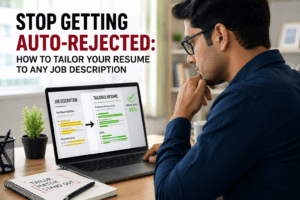
What most people do wrong is that they use the resume for every job. They also do not include the keywords. They add a lot of information that’s not necessary. They do not show what they have achieved.
You can do better by making a resume for each job. You should make sure your skills match the job description. You should keep your resume simple and easy to read. You should talk about what you have accomplished not what you did.
For example, a candidate applying for a data analyst role who adds keywords like “SQL,” “data visualization,” and “Excel dashboards” is far more likely to get shortlisted than someone with a generic resume.
Tools like JobUAI can significantly improve your chances by aligning your resume with job descriptions using AI-driven analysis. They look at your resume and the job description. They tell you what you need to do to make your resume better.
2. Initial HR Screening
If your resume gets picked the next thing that usually happens is a call with the HR people.
However, this part is often ignored by candidates.
The aim here is not to check if you’re good at your job. It’s to get to know you as a person.
You might be asked:
- Tell me about yourself
- Why do you want this job?
- What do you think you should get paid?
- When can you start?
- What do you want to do in your career?
This part is about talking well being clear and being confident.
What HR People Are Checking
- How well you can talk
- Your. How professional you are
- If what you want matches what the company can offer
- Your personality
Tips to Do Well
- Prepare an introduction about yourself
- Be honest and straightforward, in your answers
- Speak confidently but don’t sound like a robot
- Don’t memorize answers. It should sound natural
3. Technical or Skill-Based Interview
Next, this is one of the most important parts of the process.
The company checks if you really have the skills they need for the job.
In this round companies want to see if you have the skills required for the job.
They do this by giving you things to do like:
- Coding challenges
- Case studies
- Problem-solving tasks
- Questions about the area you will be working in
- Tasks that you have to finish
However, this is where many people have trouble.
This is not because they lack knowledge, but because they do not practice applying what they know.
What companies are looking for in you is
- your way of solving problems
- your thinking
- your ability to explain how you solved something
- your understanding of the concepts
- One big mistake people make is
- they only learn the theory and do not practice with real problems.
- To get ready for this you should
- practice with problems
- try to understand things do not just memorize them
- work on explaining how you think
- time yourself when you are solving problems
For instance, in a coding interview, interviewers often care more about how you approach the problem and explain your logic than whether you arrive at the perfect answer immediately.
JobUAI can help you get ready with AI mock interviews that simulate real interview environments.
4. Assignment or Case Study Round
In addition, some companies include an assignment round.
This may involve:
- Building a project
- Solving a business problem
- Creating a presentation
- Writing a case analysis
The assignment round is really valuable because it shows what you can actually do at work.
To do well in this round you need to focus on making things clear and easy to understand.
You have to explain what you are doing and how you are doing it.
Do not rush to finish it is better to take your time and do work.
You also need to pay attention to details.
Even if you are not the candidate you can still do well by showing your work in a good way.
5. Managerial Round
After that, you will meet your manager or team lead.
This part is about how you think and how you get along with people.
They want to know:
- Your way of solving problems
- How you feel about things and your way of thinking
- If you can handle situations
- If you can work well with others
- How you make decisions
You might be asked things like:
- Tell me about a time you had
- How do you deal with a lot of stress?
- Tell me about a time when you did something wrong
- How do you work with other people in a team?
Tips for this part:
- Use things that really happened to you
- Be truthful about what you have been through
- Show what you learned from times
- Talk, about how you are growing and how you think
For example, instead of saying “I handle stress well,” a strong answer would describe a real situation, the challenge you faced, and how you resolved it.
6. HR Final Round
Finally, this is usually the last step before selection.
At this point the company already thinks you are a fit.
This round is, about:
- Salary discussion
- What the company expects from you
- Company rules
- When you can start
thing to keep in mind
Be ready to talk about salary but do it in a respectful way.
7. Offer Letter
If everything goes well you will get an offer letter from the company.
It has a lot of things in it such as:
- Your salary
- Job role
- Joining date
- Terms and conditions
Take your time to read the offer letter before you say yes to the job offer. Remember to review the offer letter because the offer letter is very important. Therefore, take your time to review the offer letter carefully before making a decision.
Common Mistakes Candidates Make
Even then, people who are strong candidates can miss out due to common mistakes.
Common mistakes include:
- Not understanding the interview process
- Poor resume preparation
- Lack of confidence while speaking
- Insufficient practice
- Giving vague answers
- Not researching the company
If you can avoid making these mistakes you will have a better chance of getting the job.
How to Prepare for Each Stage
To succeed, preparation should be structured, not random.
Before Applying
- Read the job description carefully
- Customize your resume
- Understand required skills
Before the Interview
- Practice common questions
- Prepare your introduction
- Research the company
During the Interview
- Stay calm and focused
- Listen carefully
- Answer clearly and confidently
After the Interview
- Send a follow-up message
- Reflect on your performance
- Improve weak areas
How JobUAI Helps You Prepare Better
Preparing for interviews can feel confusing, especially if you don’t know where to start.
This is where JobUAI can help.
It guides candidates through every stage of the hiring process.
Key features include:
- Resume analysis based on job descriptions
- AI-based mock interviews
- Skill gap identification
- Portfolio building support
- Insights into interview patterns
As a result, you:
- Save time
- Focus on what matters
- Build confidence
- Perform better in interviews
The Future of Interview Processes
Today, interview processes are evolving quickly.
Companies are using:
- AI-based screening
- Automated interviews
- Skill-based hiring methods
As a result, hiring is becoming faster and more data-driven.
Therefore, candidates must adapt their preparation strategies and focus on practical skills.
Overall, understanding the company interview process is essential if you want to succeed.
It is not just about answering questions. It is about knowing what companies expect at each stage and preparing accordingly.
When you understand the process, prepare step by step, and stay consistent with practice, your chances of success increase significantly.
You naturally improve your chances of getting hired.
If you want to improve your chances of getting hired, create a free account on JobUAI and start building a job-ready resume, practicing real interview scenarios, and preparing with a clear strategy.
At the end of the day, interviews are not about luck — they are about preparation, clarity, and consistent execution. The candidates who understand the process and prepare for each stage are the ones who stand out and get hired.
FAQ’s
A. A company interview process is a structured set of steps that employers use to evaluate candidates for a job. It usually includes resume screening, HR interviews, technical rounds, and final discussions before selecting a candidate.
A. The 5 common stages of an interview process are application screening, HR screening, technical or skill-based interview, managerial round, and the final HR discussion or offer stage.
A. For freshers, the interview process typically includes resume shortlisting, an HR round, a technical or aptitude test, and a final interview. Since freshers have limited experience, companies focus more on skills, learning ability, and communication.
A. You can prepare by understanding each stage of the interview, practicing common questions, improving communication skills, and researching the company. JobUAI can also help by offering mock interviews, resume analysis, and personalized preparation guidance.
A. Companies use different types of interviews such as HR interviews, technical interviews, behavioral interviews, case study rounds, group discussions, and panel interviews depending on the role and company requirements.
A. Candidates often fail because they are not fully prepared for each stage, lack clarity in their answers, or do not understand what the interviewer is evaluating. Practicing regularly and using JobUAI for interview simulations can help improve performance and confidence.