You are sitting across from a hiring manager. The air is tense. They flip through your resume, look up, and say, “So, tell me about yourself,” or the dreaded variant, “Walk me through your resume.”
According to a report by LinkedIn, 93% of recruiters believe that soft skills are just as important as hard skills. How you tell your professional story—the first impression you make—is arguably the most critical soft skill in an interview. Yet, despite its significance, this is often the most poorly practiced part of the interview process.
For job seekers in India’s competitive market—ranging from fresh graduates navigating campus placements to mid-level professionals aiming for a salary hike—this question is not an invitation to recite your CV line-by-line. It is your chance to frame your experience, demonstrate your communication skills, and prove you are the missing piece of their puzzle.
This comprehensive guide will deconstruct the art of the resume walkthrough. We will explore how to structure your answer, what to highlight, how to manage time, and provide sample answers tailored for various experience levels.
The Psychology Behind the Question
Before diving into the mechanics, it is crucial to understand what the interviewer is actually asking. When they ask for a resume walkthrough, they are looking for three things:
- Clarity: Can you communicate concisely and logically?
- Relevance: Do you understand why your experience matches their needs?
- Confidence: Do you believe in your own career trajectory?
Think of yourself as a tour guide of your own career. You don’t point out every crack in the pavement (every minor daily task). Instead, you highlight the landmarks—the major projects, the promotions, and the skills acquired—that lead to the final destination: this specific job.
Structure Your Answer: The Present-Past-Future Formula
The biggest mistake candidates make is starting with, “I graduated in 2015…” This immediately makes the interviewer zone out. To keep them engaged, use the Present-Past-Future framework. This structure is particularly effective for the Indian corporate environment, where narrative flow is valued in client-facing and management roles.
1. The Present: Who You Are Now
Start with your current role or most recent experience. Summarize what you do, your key responsibilities, and a standout achievement. This anchors the conversation in the “now.”
- Example: “Currently, I am a Senior Data Analyst at XYZ Corp in Bangalore, where I specialize in predictive modeling for e-commerce clients.”
- Tip: Keep this to 20% of your total answer time.
2. The Past: The Journey of Growth
Move backward chronologically, but connect the dots. Don’t just list your previous jobs; explain the why behind the moves. Highlight the skills you gained in each role that prepare you for the next step.
- Example: “Before this, I spent two years at ABC Solutions, where I built my foundation in SQL and Python. I moved there after my degree to gain hands-on experience in large-scale data processing.”
- Tip: Focus on the last 3-5 years of experience unless older roles are highly relevant.
3. The Future: Why This Role
Bring it back to the present moment and bridge the gap to the future. Explicitly state why you are interested in this specific role and company. This demonstrates that you have done your research and are genuinely interested.
- Example: “Now, I am looking to leverage my analytical skills in a more strategic capacity. I am excited about this role at [Company Name] because of your focus on AI-driven decision-making.”
What to Highlight: Curating Your Career Narrative
Time is limited. You cannot talk about every bullet point on your CV. You must curate your content. A strong self introduction focuses on relevance, not volume.
The “Highlight Reel” vs. The “Director’s Cut”
Your resume is the director’s cut—long, detailed, and comprehensive. Your interview opening is the highlight reel. Pick 2-3 “greatest hits.”
- Quantifiable Achievements: In the Indian job market, numbers speak louder than words. Instead of saying “I improved sales,” say “I increased Q3 sales by 15% in the Northern region, generating ₹50 lakhs in additional revenue.”
- Transferable Skills: If you are switching industries (e.g., from IT to FinTech), highlight skills that cross over. Project management, stakeholder communication, and problem-solving are universal.
- Cultural Fit: If applying to a startup, highlight your adaptability and ability to wear multiple hats. If applying to a legacy firm (like a TCS or Infosys), emphasize process adherence and large-team collaboration.
Bridging the Gaps
If you have a gap in your employment history (common during the pandemic or due to upskilling breaks in India), address it briefly and positively within your narrative.
- Don’t: Ignore the gap.
- Do: “After my role at [Company], I took six months to complete a certification in Digital Marketing from IIM Ahmedabad to pivot my career towards growth roles. This led me to apply for this position.”
Tailoring for the Job Description
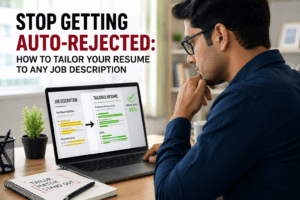
Before the interview, place your job description next to your resume. Draw lines connecting your experience to their requirements. Your resume walkthrough should emphasize these connections.
Time Management: The 90-Second Rule
The average recruiter spends just 6 to 7 seconds scanning a resume. In an interview, you have a bit more time, but you must earn their attention quickly.
Structuring Your Time
Depending on your seniority, your answer should last between 90 seconds and 3 minutes.
- 0-30 Seconds: The Present (Current role, key win).
- 30-75 Seconds: The Past (Previous 1-2 roles, progression).
- 75-90 Seconds: The Future (Why this role).
Anything longer risks losing the interviewer’s attention. If they want more detail, they will ask follow-up questions.
Avoiding the “Data Dump”
Freshers often feel the need to list every internship and college project. Resist this urge. If you have a B.Tech and an MBA, do not spend 5 minutes detailing your college life. Focus on the most recent or impactful experience.
Pacing and Pauses
Speak slowly. Nervous candidates tend to speed up. Use pauses to let key points sink in. A well-timed pause before stating a major achievement can increase its impact.
Sample Answers for Different Scenarios
Reading examples is the best way to visualize the structure. Here are two tailored examples for the Indian market.
Sample 1: The Fresher (Entry-Level)
Context: B.Tech graduate applying for a Software Developer role at a mid-sized IT firm.
“Good morning. My name is [Name], and I am a recent Computer Science graduate from [University Name].
During my studies, I developed a strong passion for backend development. My final year project, an inventory management system built using Java and Spring Boot, helped me solidify my coding skills. I also completed a six-month internship at [Company Name], where I assisted the team in optimizing SQL queries, reducing data retrieval time by 20%.
Currently, I am looking to launch my career in a dynamic environment that offers mentorship and growth opportunities. I’ve followed [Company Name]’s work in the fintech sector, and I am eager to apply my technical skills to contribute to your development team.”
Sample 2: The Experienced Professional (Mid-Level)
Context: Marketing Manager with 6 years of experience applying for a Senior Manager role in an E-commerce company.
“Hi, I’m [Name]. I am a Marketing Manager with over six years of experience driving growth for consumer brands in the digital space.
Currently, I lead the digital strategy at [Current Company], where I manage a team of five and a budget of ₹1 Crore annually. Over the past two years, I spearheaded a campaign that increased our organic traffic by 40% and improved our conversion rate from 1.2% to 2.5%.
Prior to this, I spent three years at [Previous Company], where I cut my teeth on performance marketing. That experience taught me the importance of data-driven decision-making, a skill I’ve carried into my current role.
Now, I am looking to take on a more strategic leadership role. I am particularly drawn to this position at [Company] because of your focus on AI-personalized shopping experiences, and I believe my background in scaling e-commerce brands makes me a perfect fit.”
Practice Tips: How to Rehearse Your Story
You cannot afford to wing this question. While you shouldn’t memorize a script word-for-word, you must know your key points by heart.
1. Record Yourself
Use your smartphone to record your resume walkthrough. Watch it back. Do you look confident? Do you use filler words like “um,” “uh,” or “like”? In the Indian corporate context, clear and articulate English is often a filter for higher-level roles. Recording helps you polish your pronunciation and pacing.
2. The STAR Method Integration
While walking through your resume, be ready to expand on any point using the STAR method (Situation, Task, Action, Result). If you mention a “key achievement,” you must be ready to back it up.
- Situation: “We were facing low retention.”
- Action: “I implemented a new feedback loop.”
- Result: “Retention went up by 10%.”
3. Mock Interviews
Find a mentor or a peer. Ask them to listen to your introduction and ask tough questions. Platforms like LinkedIn or local professional networks in India can be great for finding mock interview partners.
4. Handling Interruptions
Interviewers often interrupt to dig deeper. Do not take this personally. It means they are interested. Practice stopping your flow smoothly and pivoting to the detailed answer they want.
Common Pitfalls to Avoid
Even with a great structure, candidates often stumble due to these common mistakes.
The “Reading” Trap
Never read your resume. The interviewer has a copy in front of them. If you recite it, you add no value. Your value lies in the story behind the bullet points.
Oversharing Personal Details
In many cultures, including parts of the Indian workforce, personal life bleeds into professional introductions. However, in a formal interview, keep your self introduction strictly professional. Avoid mentioning marital status, family details, or political views.
Speaking Negatively
Never use your resume walkthrough to complain about a previous employer. Even if you hated your last job, frame your departure as a quest for growth and new challenges, not an escape from toxicity.
Being Too Vague
Saying “I did various tasks” or “I was involved in projects” is a red flag. Be specific. Specificity breeds trust.
Key Takeaways for the Perfect Resume Walkthrough
Mastering the walk through resume question transforms you from a nervous candidate into a confident storyteller. Remember these core principles:
- Structure is King: Use the Present-Past-Future framework to create a logical flow.
- Curate Your Content: Focus on achievements and skills relevant to the job description.
- Watch the Clock: Aim for 90 seconds to 3 minutes. Respect the interviewer’s time.
- Practice: Rehearse until your delivery is natural, not robotic.
Your resume is a static document; your interview opening brings it to life. By following this guide, you ensure that the first impression you make is one of competence, clarity, and enthusiasm.
Elevate Your Interview Skills with JobUAI
Preparing for the “walk me through your resume” question is just the first step. To truly ace your interviews and land your dream job, you need continuous practice and feedback.
JobUAI is an AI-powered interview preparation platform designed to help job seekers like you. With JobUAI, you can:
- Practice your resume walkthrough with an AI simulator that provides real-time feedback.
- Analyze your body language and speech patterns to improve confidence.
- Access a library of domain-specific questions tailored to the Indian job market.
Don’t leave your career to chance. Sign up for JobUAI today and turn your interview anxiety into interview mastery.
FAQ’S
This question asks you to summarize your education, skills, and work experience in a clear and structured way, highlighting how your background fits the job role.
Interviewers ask this question to understand your career journey, achievements, and relevant skills, and to see how well you communicate your experience.
A. Your answer should usually be 1–2 minutes long, covering key points without giving too many unnecessary details.